
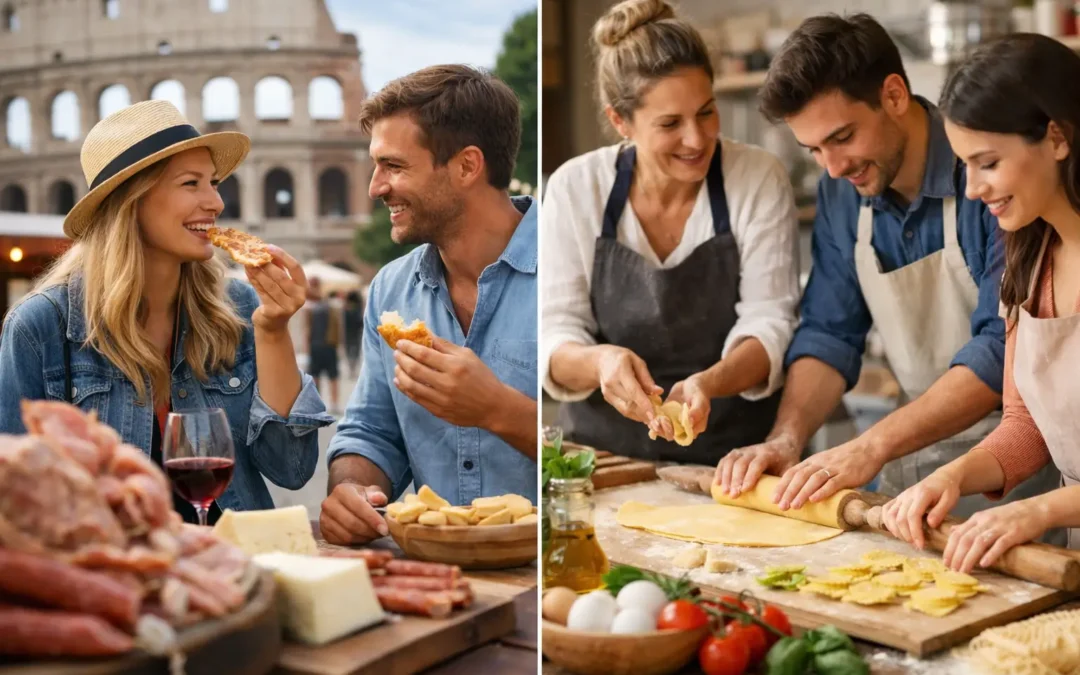
The hardest part of eating well in Rome is not finding food. It is choosing among the hundreds of tempting places, dishes, and neighborhoods when your vacation time is short. If you are deciding between a Rome food tour or cooking class, the right answer comes down to how you want the day to feel: a lively taste of the city, or a slower, hands-on meal you help create.
Both experiences can become a highlight of a Rome trip. One introduces you to the flavors and characters of several local stops. The other gives you an apron, a recipe, and the pleasure of sitting down to something you made yourself. Here is how to choose the experience that suits your travel style, schedule, and appetite.
Rome Food Tour or Cooking Class: Start With Your Travel Style
Choose a food tour when you want Rome to unfold around you. You will walk through a neighborhood, stop at food shops or family-run spots, and taste your way through specialties that might include pizza al taglio, supplì, cured meats, cheeses, pasta, gelato, and a glass of local wine. The food matters, of course, but so do the streets between each bite. A good guide helps you notice the details you might otherwise pass by: how Romans order coffee, why one bakery is known for a particular bread, or which pasta belongs to a traditional local recipe.
A cooking class is better when your favorite travel memories happen around a table. Rather than sampling many places, you spend meaningful time in one welcoming setting. You may learn to make fresh pasta, a Roman sauce, tiramisu, pizza, or another classic dish, then enjoy the meal together. It is less about covering ground and more about slowing down, asking questions, getting your hands floury, and taking a little piece of Italy home with you.
Neither choice is more authentic by default. Authenticity comes from the people, the ingredients, the story behind the food, and the time you have to enjoy it. The best option is the one that matches the kind of day you want.
Choose a Food Tour When You Want to See More
For first-time visitors, a food tour can be an easy and delicious introduction to Rome. It gives structure to an area that may feel overwhelming on your own, especially when every corner seems to promise the “best” carbonara or gelato. A local guide can turn a few hours of eating into a useful neighborhood orientation.
This makes food tours especially appealing early in your stay. You can learn which dishes to look for, gain confidence ordering in restaurants, and receive practical local perspective without spending your evening scrolling through reviews. If you are staying near the city center, a walk through historic lanes, a market area, or a character-filled neighborhood can add food, culture, and sightseeing to one outing.
Food tours also work beautifully for couples with different interests. One person may be focused on pasta and wine, while the other wants the atmosphere, history, and photos. Because the experience moves through the city, everyone has something to enjoy. It is also a smart pick for travelers who do not want to cook on vacation or who have only a single afternoon free.
There is a trade-off. You will taste many things, but you will not gain the same practical skill as you would in a class. Portions are often paced across multiple stops, so arrive hungry but do not expect every tasting to be a full restaurant serving. The pleasure is in variety and discovery.
The Best Moments for a Food Tour
A food tour is often the better fit for your first or second day, a short city break, or an afternoon when you want a guided plan without a museum schedule. It is also ideal for guests who want recommendations they can use for the rest of their trip. If you are curious about regional ingredients, neighborhood traditions, and where locals actually stop for a quick bite, this is your lane.
Choose a Cooking Class When You Want to Participate
A cooking class has a different kind of magic. You are not just served a plate of pasta. You learn why the dough feels right, how the sauce comes together, and what makes a simple Italian dish taste so satisfying. Then you share the result at the table, usually with plenty of conversation along the way.
For couples, it can feel like a date with a very good dinner at the end. For families, it is one of the rare travel activities where kids and adults can be equally involved. Children love rolling dough, shaping pasta, and helping with dessert, while parents appreciate an experience that is interactive without requiring a long attention span in a gallery or church.
A class can also be particularly rewarding if you have already eaten your way through a few Roman restaurants and want to understand the food more deeply. You may leave with techniques that are surprisingly realistic to repeat in an American kitchen. The ingredients will not always be identical at home, but the confidence and memories travel well.
The trade-off is time and location. A cooking class generally keeps you in one place for several hours, so it is not the best choice if your main goal is seeing several neighborhoods in a day. It is also a more focused food experience. If you are hoping to taste pizza, cheese, pastries, wine, street food, and several pasta dishes all in one outing, a food tour gives you more range.
The Best Moments for a Cooking Class
Book a cooking class for a relaxed evening, a rainy-day plan, a family day, or the final night of your trip when you want an experience that feels celebratory. It is also a wonderful answer to the question, “What can we do that is more memorable than another dinner reservation?” You still eat, but the meal has a story you helped write.
Consider Your Group, Pace, and Food Needs
Your group dynamics can make the decision clear. Active travelers and curious eaters often love the momentum of a walking food tour. Guests with limited mobility, young children, or a preference for a more settled setting may find a cooking class more comfortable. That said, the right experience can be adapted. A shorter route, private pace, seated tastings, or a class designed for families can change the feel of the day entirely.
Dietary needs deserve an honest conversation before booking. Rome has wonderful options for vegetarian travelers, and many food experiences can accommodate allergies or dietary preferences with advance notice. Still, traditional Roman cooking relies heavily on wheat, eggs, cheese, pork, and sometimes nuts. A well-planned experience should be transparent about what can be adjusted and what may not be possible without changing the dish completely.
Timing matters, too. A morning class can leave your evening free for a sunset walk and aperitivo. A daytime food tour can replace lunch and free you from another planning decision. An evening food experience feels festive, but save room and avoid scheduling it right after a large hotel breakfast or a long lunch.
Make It Personal Instead of Following a Script
The most memorable choice is often not simply “food tour” or “cooking class.” It is choosing an experience shaped around your interests. Maybe you want a private food walk with extra attention to wine and classic Roman pasta. Maybe your family wants a pasta-making class where the children can join in. Maybe you are celebrating an anniversary and would rather combine a food experience with a quiet, less-touristy neighborhood stroll.
This is where a little local planning makes a real difference. At RomeTour24, we love helping visitors build days that feel easy rather than overplanned. Tell us what you enjoy, how much time you have, who is traveling with you, and whether you want to walk, cook, taste, or do a little of everything. A personal recommendation is always better than forcing your vacation into a standard itinerary.
If you still cannot decide, think about the story you want to tell when you get home. Do you want to say, “We found the city one bite at a time,” or “We made pasta in Rome and sat down to eat it together”? Both are delicious answers. Choose the one that makes you smile now, then come hungry. See you in Rome.